
My swans,
Art holds a particular weight within this curriculum.
It is revealing, it captures something poignant in a single frame that might take pages to articulate elsewhere. A gesture, a gaze, a composition. Small details that carry entire tensions and layers of story beneath them.
And for a month like April, where our guiding themes are Love, Society, and Moral Hypocrisy, that kind of precision is delicious. Because these are themes that exist in subtle spaces and in what is implied rather than stated.
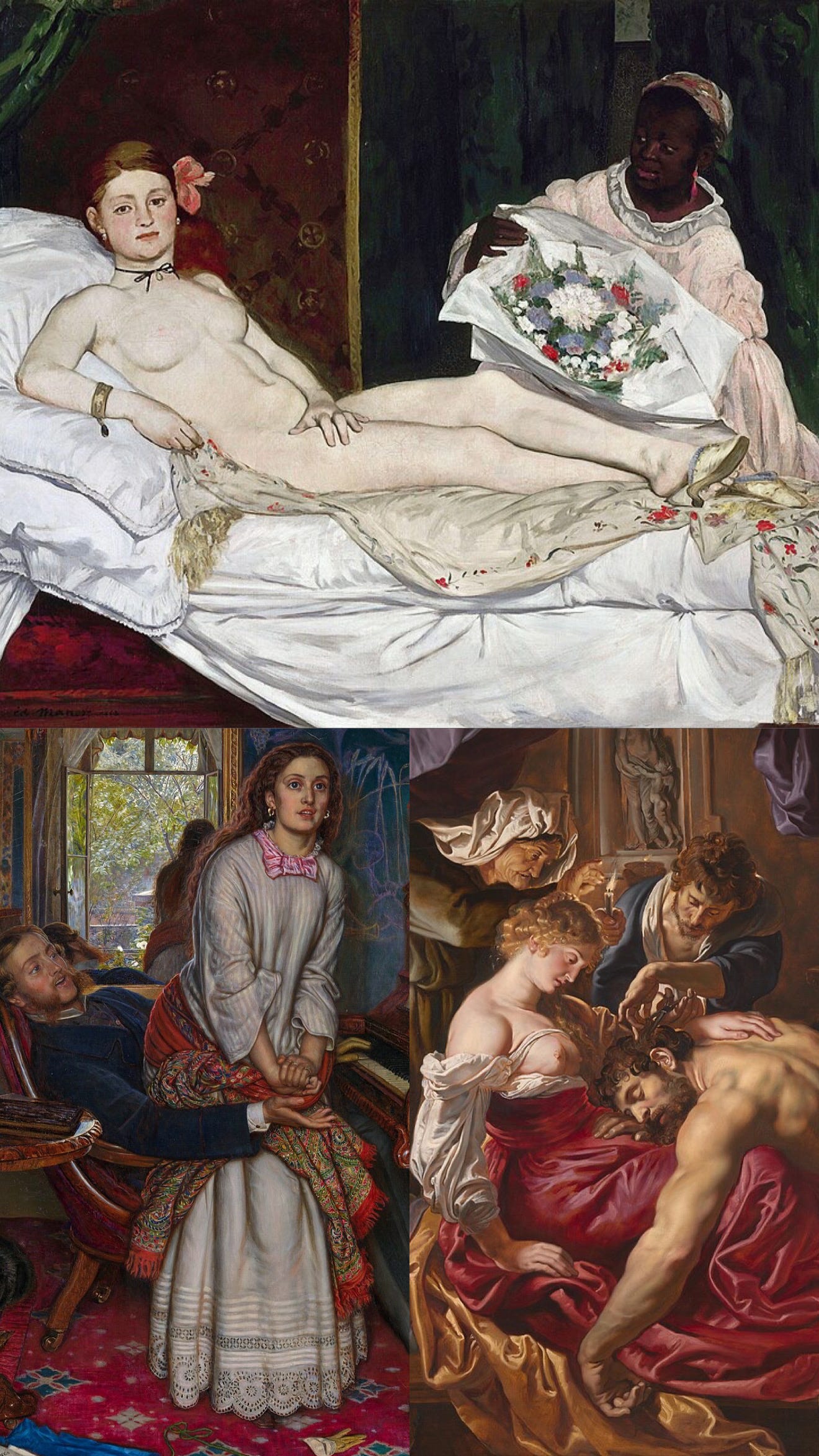
So this month, we are going to move through three paintings that feel especially sharp in this regard. Each one isolates a different kind of tension—between awareness and circumstance, between visibility and concealment, and between intimacy and betrayal.
We will take them one by one.
And in doing so, begin to see not just what is being shown, but what is silently simmering beneath it.
The Awakening Conscience - William Holman Hunt
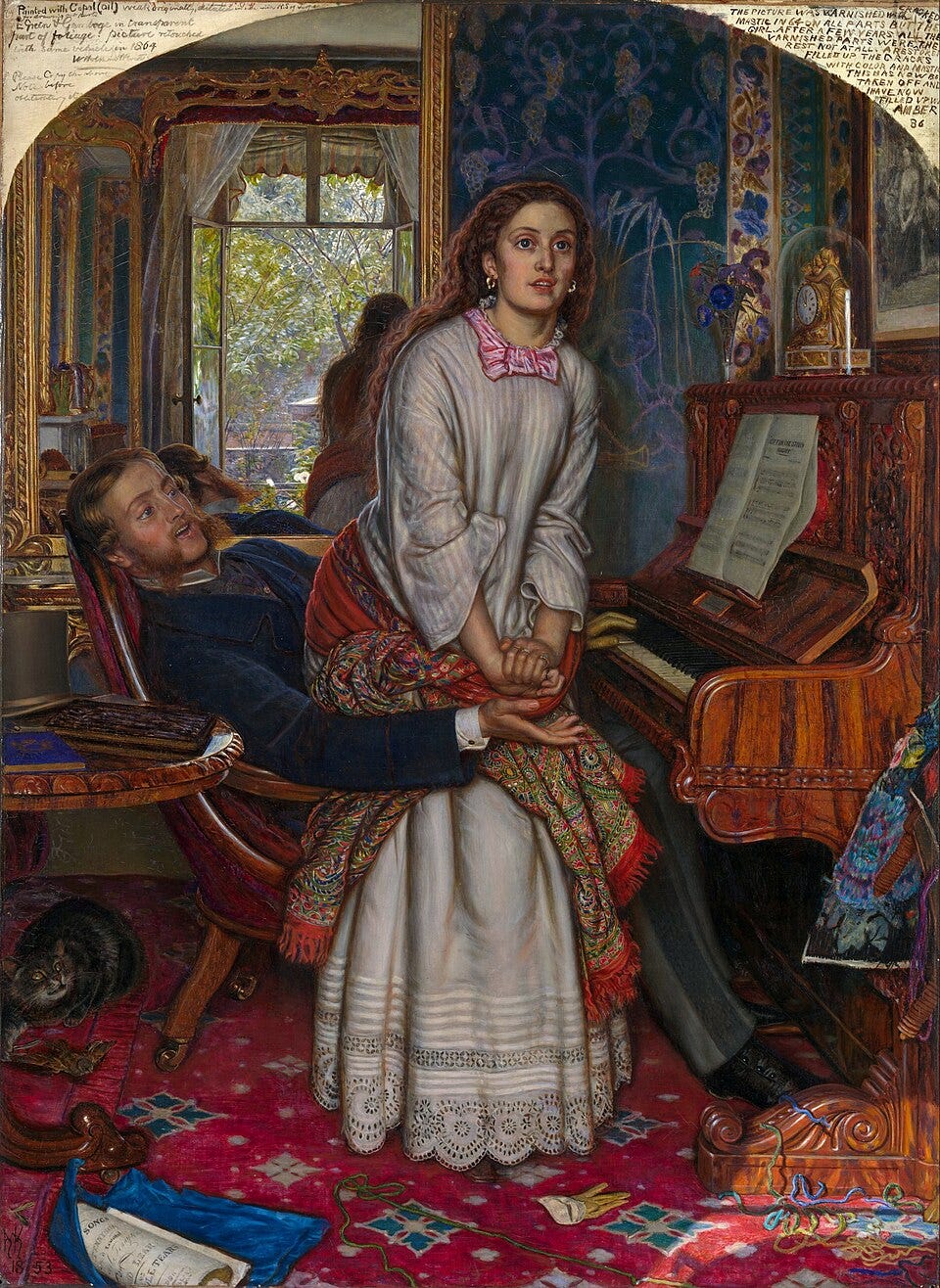
Let’s start with The Awakening Conscience. To start with a simple description, this painting depicts a young woman rising suddenly from a man’s lap in a very richly decorated interior. The man remains seated at the piano, his arm still loosely around her, while she turns away from him toward the light coming through the window. Her expression is unsettled, arrested, as if something has just interrupted her internally.
What is being shown is a kept woman in her lover’s home, placed within a life that appears comfortable (ornate furniture, patterned carpets, etc.) but is fundamentally precarious. The title directs the reading: this is a moment of moral realization.
The shift is contained entirely within her and nothing external forces it. The man seems to not even react and the whole scene is entirely steady apart from the movement of her awareness.
That contrast gives the painting its tension. Her posture breaks from the structure that surrounds her. The space suggests stability, but her movement introduces the possibility that it cannot hold her. Love here is tied to arrangement — financial, social, situational. It exists within a framework that had been sustaining it quietly, until it becomes visible from the inside.
What makes this moment so sharp is how clearly it sits at the intersection of love, society, and moral hypocrisy. What has been framed as love is revealed to be something structured by dependence and circumstance. The relationship is not separate from the social conditions that make it possible, it is defined by them. And within that structure, a certain kind of hypocrisy is required to sustain it. The arrangement can continue as long as it remains unexamined, as long as it is experienced as comfort rather than constraint. But her awareness interrupts that and exposes the gap between what the relationship appears to be and what it actually is.
Olympia - Édouard Manet
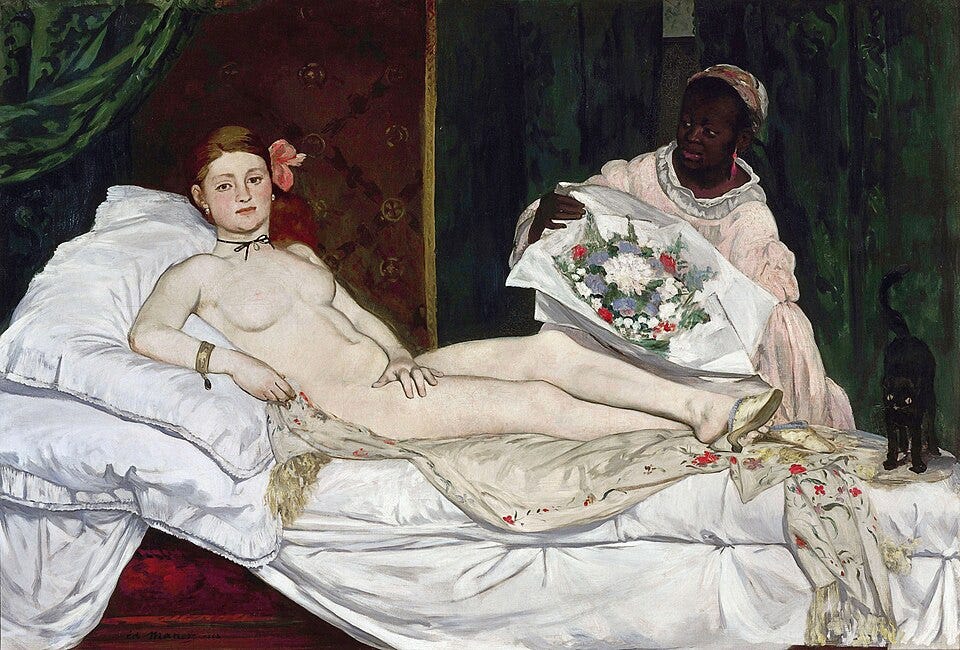
Olympia is our next painting and it presents a woman lying on a bed, facing the viewer directly. She is nude, her body positioned in a way that recalls classical reclining figures, but without the idealization typically associated with them. Her gaze is steady and direct. One hand rests firmly across her body, controlling access rather than inviting it. At the foot of the bed, a servant offers her a bouquet of flowers, likely from a client.
The subject is a prostitute, though the painting does not disguise this through narrative or symbolism. It places her in full view, without altering the terms of what is being depicted.