
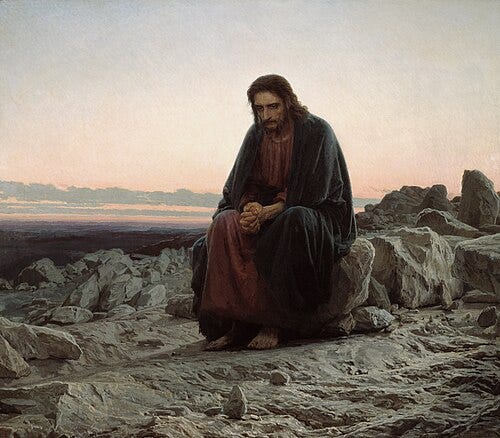
Most religious paintings show us what Christ does, the miracle, the act. This one stays with him in the moment before, when no one is watching.
Painted in 1872, this work depicts Christ during the forty days in the wilderness, the period in the Gospels where he fasts and is tempted before beginning his public ministry.
Most depictions of this moment choose to portray the performance. The devil appearing, the visible temptation, and some sense of confrontation.
Interestingly, Kramskoi removes all of that and leaves us with just Christ seated on a rock at dawn, hands tightly clasped, body drawn inward, and the landscape is cold and barren.
Nothing about the environment suggests transcendence. If anything, it reinforces isolation. So what you are left with is not a biblical event in motion, but a moment before something irreversible.
The artist (and why this looks the way it does)
Ivan Kramskoi was a central figure in the Russian realist movement and part of the Peredvizhniki (the “Wanderers”), a group that rejected academic idealization in favor of psychological and moral realism.
They were interested in interior life (like us swans), ethical tension, and essentially the human condition stripped of any ornament.
Kramskoi’s Christ, unlike many portrayals which are stylized and glorified, is physically exhausted and psychologically burdened.
Kramskoi reportedly worked on this painting over a long period, returning to it repeatedly because he was less interested in illustrating scripture and more interested in capturing what he saw as the most difficult aspect of it which was not the suffering itself, but the decision to accept it.
Now onto our three themes we are exploring this month: Faith, Innocence, and Moral Suffering.